Showing posts with label Cholas. Show all posts

Thursday

Nayaka and Maratha Art in Thanjai Periya Koil (Brihadisvara Temple)

Though the Thanjai Priya Koil (Brihadisvara Temple) was built by the Cholas in the 10th Century CE, artistic additions were made by the Nayaka and Maratha rulers in the 16th and 17th Century CEs.
Nandhi (bull), the vahana of Brihadisvara (Lord Siva) in front of the sanctum sanctorum was built by the Nayaka rulers in the early 16th century CE.
Nandhi - the vahana (transport) of Lord Shiva - SOOC

The sheer size of the Nandhi itself is impressive. Again, the mandapam (hall) is filled with artistic sculptures, including the Nayaka king himself!
Nayaka ruler, who built the Nadhi Mandapam - Shadow Shot Sunday 2 and Sky Watch

Story telling sculptures in different colored granite stones! These sculptures either reflect day-to-day life in those days or scenes from Hindu puranaas (epic).

Here is the story of the above sculptures
1 - Hanumaan carrying Sanjeevi hills as per Hindu Epic Ramayana
2 - Siva devotee
3 - Night watchman - note the stone carved cloak covered from his head and the stick
4 - Dancing girl - holding a creeper
Maratha rulers invaded Thanjai during 17th/18th Century CE. They further adorned the temple with bright paintings, including the ceiling of Nandhi mandapam!
Maratha painting

More art work in the pragaaras (buildings/halls around sanctum sanctorum)...
Gaja Lakshmi

Goddess Gaja Lakshmi is one of the 8 forms of Lakshmi, and represents prosperity and good luck. You can see that this deity sits in Padmasana, one of the best yoga postures!


Kaali

Goddess Kaali is an incarnation of Parvathi or Sakthi, Consort of Lord Shiva. Kaali is associated with destroying evil and She is believed to be the redeemer of life.
It is amazing to see these time tested art and architecture. Every time I visit this temple, I guess I will have more pictures and stories to tell!




Friday

Thanjai Priya Koil (Brihadisvara Temple) - 10th Century Chola Living Temple

My love for Thanjai temple (Thanjavur Big Temple or Brihadisvara Temple) had flared up after reading the historical fiction 'Ponniyin Selvan', by Kalki. Well, the fiction is deeply rooted in the life and achievements of Raja Raja Cholan, the great Indian ruler of the Chola dynasty.

As per the novel, Raja Rajan developed a strong desire to build a huge temple for Lord Shiva after he returned from his successful invasion of Sri Lanka. There, he had seen colossal Buddha statues  all over the country. The monks had told him that lofty Buddha statues represents endless mercy and divine nature of their Lord, Buddha. Attracted by this concept, Raja Raja wanted to build a monumental temple that would befit Lord Siva in his kingdom as well!

Each step that I took in the Periya Koil was nostalgic and I was imagining the days when the temple was built. Kalki’s description of Chola artisans came alive and I had goose bumps just by wondering how Raja Raja managed to design this architectural wonder, in those days! It must have been a herculean task. With capable leadership, strong design skill and raw man power, Raja Raja had managed to build an architectural wonder! It felt so good to walk on the same path of the 10th Century CE legendary ruler!
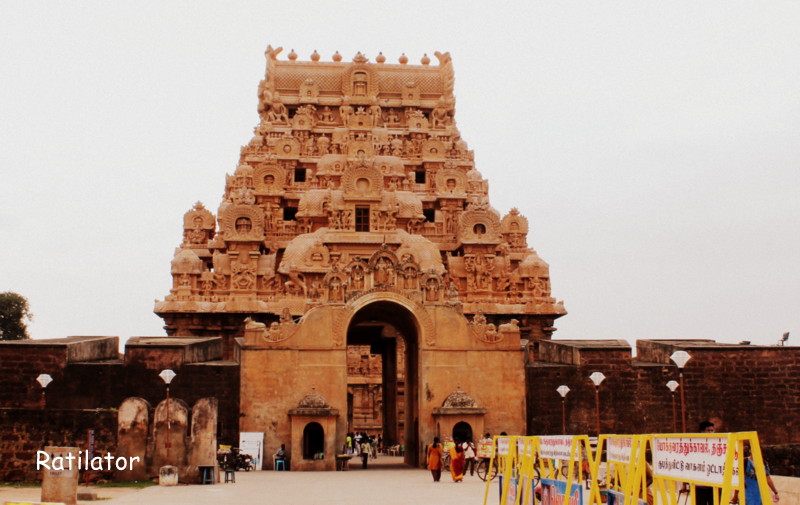
The Maratha Fort Entrance and Keralanthakan Gopura (tower)

The gopura (tower) you see in the above picture was built in the 10th century CE to commemorate the victory of Raja Raja Chola over the Kerala rulers of the Chera Dynasty! However, the Maratha rulers of the 16th/17th Century CE, added the fort that is shown in the foreground of the above shot.
Layout of the temple and the inscription briefing about the temple

This has been declared as World Heritage site by UNESCO, but locally it is yet to gain the due recognition:(
2nd entrance - Raja Rajan Gopuram

Sculptures and inscriptions in the Raja Rajan Gopuram

No words to describe the beauty, and am sure my pics do not justify the grandeur of the granite carvings!
The majestic courtyard with huge Nandhi Mandapam and renowned granite Raja Gopuram (Main Tower) in the background

Before, going into the main temple, you will be awed by the larger than life Nandhi. This will be covered in a separate post.
Side view

Lord Siva resides in this temple in the name of Brihadisvara or Peruvudayar. Like any living temple, cameras are not allowed in sanctum sanctorum.
The dome is a single granite weighing around 81 tonnes!

This tower is built in such a way that the shadow NEVER falls on the ground! Just can't guess how Raja Raja managed to design this architectural wonder, in those days!!!
Let me show you some beautiful sculptures in the external walls...
Goddess - Sakthi on the left and Vishnu Durga on your right

Gate Keeper! - SOOC

Legendary warriors!?


Even the less visible side walls are adorned with sculptures and stone inscriptions. In fact, these inscriptions are a treasure trove that details the life in Chola period.
Here is the abode of Murga, son of Lord Siva

Each step that I took in the temple was nostalgic and I was imagining the days when the temple was built. It felt so good to walk on the same path of the 10th Century CE legendary ruler!


Saturday

6th Century Sri Somanathaswamy Temple @ Palayarai

As a die-hard fan of Kalki's historical novel பொன்னியின் செல்வன் (Ponniyin Selvan) I've always dreamt of visiting the places mentioned in that novel. Most of the places are near my Home town, Madurai in India. During this visit I managed to visit two top destinations, Palayarai and Thanjavur.

Palayarai, was the first capital of Medieval Cholas, until Thanjavur was built around 10th Century CE. Now, only a ruined Shiva temple is present at that place. We had to stop and ask for directions at several places, as Palayarai has lost its glory and now it is an insignificant sleepy village.

Ruins of the temple - viewed as we turned in that village

My heart sank, when I saw the locked gates of the ruined the Raja Gopuram (Tall tower) However, I got down from the car to take some shots of the tower and beautiful sculptures along the wall.

Only 2 levels of the gopuram exists

Pathetic reminder of the past glory:(

In remote villages, even now if they see a car, the villagers approach it with great curiosity! My dad asked one such villagers if there is anyone who could help us in entering the temple...'don't worry, the temple in-charge would have seen your car and anytime he would he here', before he finished the sentence, the in-charge came there with the keys!!!

Shrine of the Goddess


There is only limited online literature about this temple and town, so I tried to gather local info/folklore from the in-charge person. He said that this temple is more than 1400 years old...true it was built by the Chola dynasty in in 6th Century CE. He added that Raja Raja Cholan, the famous Chola king used to worship here before he built the Thanjvur Periya koil in the 10th Century CE.

The sanctum sanctorum of Lord Somanathaswamy

This shrine is designed like a horse drawn chariot!

Stone horse n wheel

It is unacceptable as per the Hindu customs to take pictures of the main deity...however, I did click at one of the most powerful Goddess worshiped by the kings, especially to give them moral and physical courage during war times.

Goddess Durga - carved out of single stone!

The half-gone murals behind the Goddess is supposed to be done by the Maratha rulers around 16th Century CE. Luckily, no one had tried to white-wash it!

Ardhanareeswara

Ardhanareeswara - is a beautiful concept where Lord Shiva manifests Himself as Half Man and Half Woman, to show that the male and female powers should co-exist! Later, on the same day, we saw similar beautiful sculptures in Thanjavur Periya Koil as well.

Yali - For SOOC


Yali, is a Hindu mythological creature, with Lion's head on a horse's body and this form is usually seen in Shiva temples.

The in-charge said that the temple renovation was underway as they were planning for Kumbabishekam. Now, I've mixed feelings, because they were sort of destroying our heritage by white-washing the precious, beautiful stone buildings and sculptures:(

Again, I've a big misgiving on Indian Archeological Dept, as to why do they fail to promote our assets? At least, can't we take care and preserve such glorious monuments of historical importance?!

Related Posts Plugin for WordPress, Blogger...