Showing posts with label Temple. Show all posts

Thursday

Nayaka and Maratha Art in Thanjai Periya Koil (Brihadisvara Temple)

Though the Thanjai Priya Koil (Brihadisvara Temple) was built by the Cholas in the 10th Century CE, artistic additions were made by the Nayaka and Maratha rulers in the 16th and 17th Century CEs.
Nandhi (bull), the vahana of Brihadisvara (Lord Siva) in front of the sanctum sanctorum was built by the Nayaka rulers in the early 16th century CE.
Nandhi - the vahana (transport) of Lord Shiva - SOOC

The sheer size of the Nandhi itself is impressive. Again, the mandapam (hall) is filled with artistic sculptures, including the Nayaka king himself!
Nayaka ruler, who built the Nadhi Mandapam - Shadow Shot Sunday 2 and Sky Watch

Story telling sculptures in different colored granite stones! These sculptures either reflect day-to-day life in those days or scenes from Hindu puranaas (epic).

Here is the story of the above sculptures
1 - Hanumaan carrying Sanjeevi hills as per Hindu Epic Ramayana
2 - Siva devotee
3 - Night watchman - note the stone carved cloak covered from his head and the stick
4 - Dancing girl - holding a creeper
Maratha rulers invaded Thanjai during 17th/18th Century CE. They further adorned the temple with bright paintings, including the ceiling of Nandhi mandapam!
Maratha painting

More art work in the pragaaras (buildings/halls around sanctum sanctorum)...
Gaja Lakshmi

Goddess Gaja Lakshmi is one of the 8 forms of Lakshmi, and represents prosperity and good luck. You can see that this deity sits in Padmasana, one of the best yoga postures!


Kaali

Goddess Kaali is an incarnation of Parvathi or Sakthi, Consort of Lord Shiva. Kaali is associated with destroying evil and She is believed to be the redeemer of life.
It is amazing to see these time tested art and architecture. Every time I visit this temple, I guess I will have more pictures and stories to tell!




Friday

Thanjai Priya Koil (Brihadisvara Temple) - 10th Century Chola Living Temple

My love for Thanjai temple (Thanjavur Big Temple or Brihadisvara Temple) had flared up after reading the historical fiction 'Ponniyin Selvan', by Kalki. Well, the fiction is deeply rooted in the life and achievements of Raja Raja Cholan, the great Indian ruler of the Chola dynasty.

As per the novel, Raja Rajan developed a strong desire to build a huge temple for Lord Shiva after he returned from his successful invasion of Sri Lanka. There, he had seen colossal Buddha statues  all over the country. The monks had told him that lofty Buddha statues represents endless mercy and divine nature of their Lord, Buddha. Attracted by this concept, Raja Raja wanted to build a monumental temple that would befit Lord Siva in his kingdom as well!

Each step that I took in the Periya Koil was nostalgic and I was imagining the days when the temple was built. Kalki’s description of Chola artisans came alive and I had goose bumps just by wondering how Raja Raja managed to design this architectural wonder, in those days! It must have been a herculean task. With capable leadership, strong design skill and raw man power, Raja Raja had managed to build an architectural wonder! It felt so good to walk on the same path of the 10th Century CE legendary ruler!
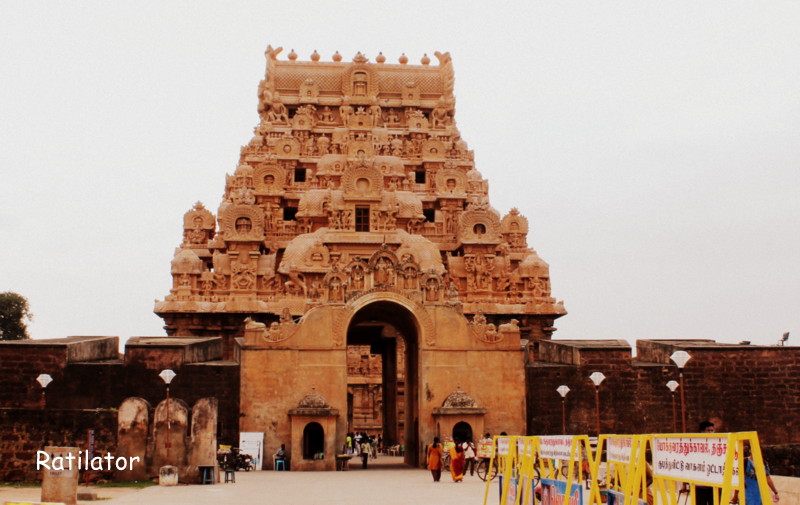
The Maratha Fort Entrance and Keralanthakan Gopura (tower)

The gopura (tower) you see in the above picture was built in the 10th century CE to commemorate the victory of Raja Raja Chola over the Kerala rulers of the Chera Dynasty! However, the Maratha rulers of the 16th/17th Century CE, added the fort that is shown in the foreground of the above shot.
Layout of the temple and the inscription briefing about the temple

This has been declared as World Heritage site by UNESCO, but locally it is yet to gain the due recognition:(
2nd entrance - Raja Rajan Gopuram

Sculptures and inscriptions in the Raja Rajan Gopuram

No words to describe the beauty, and am sure my pics do not justify the grandeur of the granite carvings!
The majestic courtyard with huge Nandhi Mandapam and renowned granite Raja Gopuram (Main Tower) in the background

Before, going into the main temple, you will be awed by the larger than life Nandhi. This will be covered in a separate post.
Side view

Lord Siva resides in this temple in the name of Brihadisvara or Peruvudayar. Like any living temple, cameras are not allowed in sanctum sanctorum.
The dome is a single granite weighing around 81 tonnes!

This tower is built in such a way that the shadow NEVER falls on the ground! Just can't guess how Raja Raja managed to design this architectural wonder, in those days!!!
Let me show you some beautiful sculptures in the external walls...
Goddess - Sakthi on the left and Vishnu Durga on your right

Gate Keeper! - SOOC

Legendary warriors!?


Even the less visible side walls are adorned with sculptures and stone inscriptions. In fact, these inscriptions are a treasure trove that details the life in Chola period.
Here is the abode of Murga, son of Lord Siva

Each step that I took in the temple was nostalgic and I was imagining the days when the temple was built. It felt so good to walk on the same path of the 10th Century CE legendary ruler!


Monday

Karagattam - Folk Dance

Any village festival in Tamil Nadu is sort of incomplete without Karagattam. Until, my last trip to India, I never had a chance to meet and take pics of the dancers. This time round, we met a group in Namakkal, (Tamil Nadu, India) who were practicing for a competition! So I'd a good photo opportunity:)

Balancing the karagam - For SOOC and Shadow Shot Sunday 2
Yes, balancing this pot (Karagam) on top of the head without holding it and performing graceful, yet fast paced dance (attam) movements is KARAGAATAM!

Ready to dance

Until then, I used to wonder if they tie up or 'glue' the pot on their head and disguise with makeup! But now, for sure I know that it is purely an art of balancing the decorated 'karagam', which is most important to start the attam!!!

They dance with so much grace that it is hard to believe how the pot royally sits on their heads.

At times, as a challenge, they lie down on their stomach by few dexterous movements and pick up a small piece of wood or fruit from the ground, while balancing the karagam!!!

The dancers are called as 'karagattakaran (men) and karagattakari (women). The music is also very peepy and you feel like tapping your foot.

The man in white is musician of this troupe!

Karagattam should be highly regarded and encouraged. But, it is not considered as 'fashionable' among city dwellers, so, I feel that this form of art is under suffocation.

Friday

Mottai Gopuram - Towers of Meenakshiamman Temple - Madurai

Whenever I go to Madurai, my home town in India, I must go to Meenakshi Amman Temple, if not my home coming is never complete! Besides having a satisfactory darshan, I enjoy walking around the temple soaking up in the beauty of the tall கோபுà®°à®®்(towers), பொà®±்à®±ாமரை குளம் (Golden Lotus Pond), and story telling sculptures! Here is a view of North Tower.

North Tower - Mottai Gopuram

All the towers are adorned with beautiful sculptures that depict stories from puranas (legand/mythology). However, this tower is almost bare and the locals call this as à®®ொட்டை கோபுà®°à®®் (bare tower!?). The legend says that all the towers in this temple was built overnight by the bhootahganaas (Lord Shiva's heavenly followers). Sunrise occurred while building the north tower, so it was left incomplete!


View from Inside

Here is a shot of South Tower, which is filled with story telling sculptures...

South Tower
Related Posts Plugin for WordPress, Blogger...